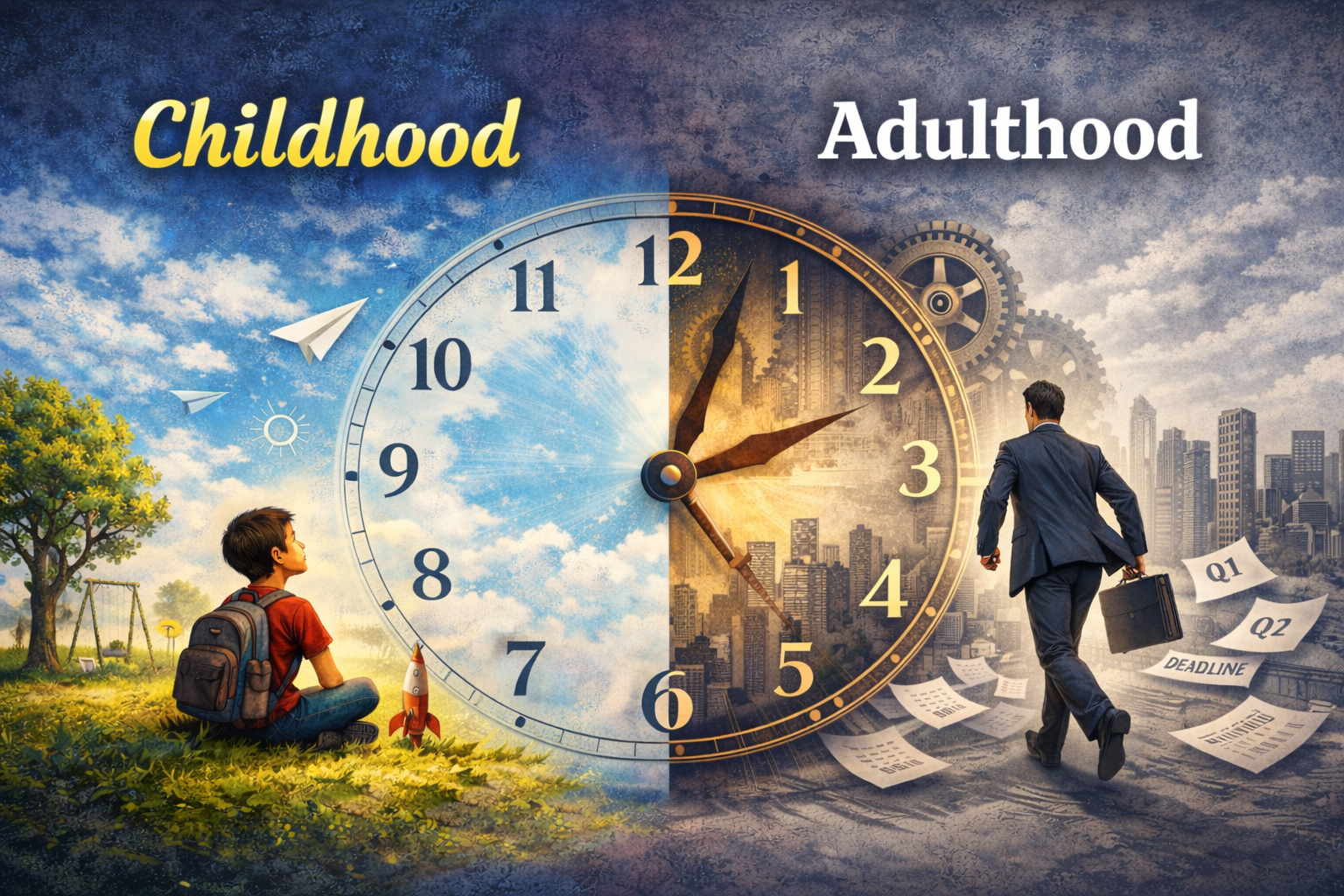
A Fresh Perspective on Time: Childhood vs. Adulthood
I work in the field of time management, which means I used to think in terms of long-term time management: twelve months of the calendar stretching out before me, one year flowing seamlessly into the next as an endless conveyor belt of goals, responsibilities, and “next time around.” But what if we take a step back and look at time the way a child does? Compare that to the way we, as adults, divide, categorize, and hurry through time? Most of us have complained, “There just aren’t enough hours in the day to get all of these things done!” We listen to the elderly talk about how time seems to speed by as you get older, and we dismiss the phenomenon as an older person’s complaint, until suddenly we find ourselves in the same situation. So, the question becomes: Is it possible to look at time from different perspectives and different senses of urgency? If so, what can we learn from these different perspectives?
Childhood: Time That Appears Infinite
When you’re five years old, you know you have an eternity of time in front of you. Every day brings a new wonder to explore, a new thing to learn. You rush headlong through your days, eager to be seven so you can “finally” do the thing you really want to do, eager to be ten so you can get the thing you really want. And then, almost before you know it, time delivers. You wake up one day and find you’re a teenager, and you look back on those days of counting down the years until you could do the thing you really wanted to do, and you see that you’ve been training yourself to think about the future, not the present. Childhood teaches you two important lessons about time:
• We stretch time with curiosity.
• We compress time with impatience.
If we do not become aware of these tendencies, these patterns of behavior carry over into our adult lives.
Teen Years: Testing Time and Boundaries
When you turn thirteen, you know you’re a teenager. You know you’re finally in charge of your own life. Or so you think. In reality, your parents still dictate your bedtime, your teachers still expect you to get your homework done, and some other person still controls the alarm clock you wake to. Yet something about being a teenager gives you a sense of freedom. Peer pressure, group texts, a part-time job, and late nights spent staring at a phone screen give you a sense of what you can get away with. You find out how late you can stay out, how late you can stay up, how late you can go out with friends. You find out how well you can take care of yourself and your own time. This is the period of your life where you may find out how much of a rebel you can be. This is the period of your life where you may find out how much of a free spirit you can be.
Business & The Four Quarters Mindset
As human beings, we progress from childhood to adolescence to young adulthood. But businesses don’t progress that way. They progress from quarter to quarter. Most businesses operate on a four-quarter cycle:
• Q1 – Set the tone, launch the year.
• Q2 – Adjust, refine, push.
• Q3 – Navigate the lull/surge.
• Q4 – The final push, from November to December, where business leaders get a surge of urgency to meet the year’s objectives.
In the last weeks of the year, businesses suddenly prioritize time as a precious, finite resource. Emails are returned, decisions are made, and people stay late at the office, determined to finish the year strong. But what if you carried that same level of urgency into the rest of the year, not just the last weeks of the year?
Living with 12-Week Urgency
Brian P. Moran’s book, The 12 Week Year, is an excellent example of how one can achieve this. Instead of thinking of a year as a long, indefinite period of time of 12 months, one should consider 12 weeks as their “year.” This means setting definite objectives, being focused, and evaluating progress at the end of the 12 weeks. This has two important benefits:
• It helps minimize procrastination, as one is reminded that the deadline is always near.
• It increases awareness, as every week is important, every hour and every second is important.
Another author who wrote about this concept of a 12-week cycle of productivity is Charlie Gilkey in his book, Start Finishing: How to Go from Idea to Done. In this book, he provides a 12-Week Project Road Map” which I found to be very useful.
Time, Consequences, and Useful Skills
Time is always neutral; it is your choices that give it weight, direction, and meaning. Whether you are a teenager, a young adult, or a seasoned professional, every 12-week block of your life is a powerful chance to reset your focus, correct your course, and act on what matters most. As the author of the time-management novel Time & Consequences, I have seen—on and off the page—how quickly our small decisions with time compound into very different futures.
If you want to see real change, stop waiting for “someday” and start treating the next 12 weeks as your year. Break your goals into clear, specific targets, review your progress every week, and decide—on purpose—how you will spend each day. Life is too short not to achieve your greatest potential, and your greatest potential begins with how you use your time right now.